Art + Commerce — Tight integration of brand & tools
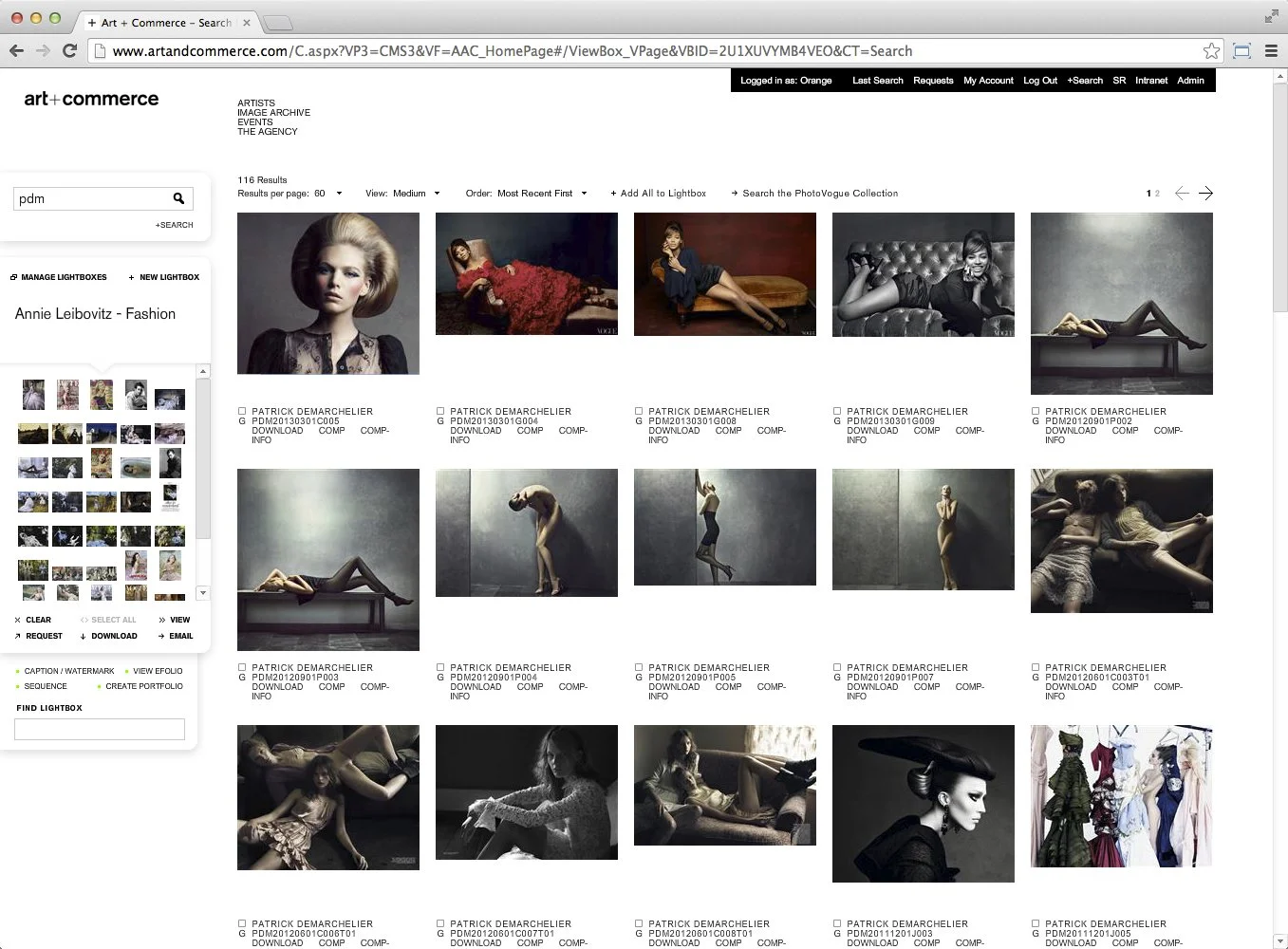
The who, what, when, where, why, and how
WHO
Everyone. A complex mix of personas and needs to meet.
Image Archive Licensing Agents, licensing images to Art Buyers
Art Buyers, licensing images for magazines
Creative Directors, hiring photographers
Photographers' Agents, managing online portfolios and sending specific portfolios to agencies.
Photographers checking on their sales and online presence
Accounting Staff, managing royalty payments
And a considerable crowd of fans, students, and photography enthusiasts
WHEN and WHAT
2004 — Almost 20 years ago, Pengram had just finished its website redesign presentation to the Partners. Lisa Naftolin, Shigeto Akiyama, and I left the room disappointed and wondering what we would do.
I told them we were looking at the problem from a too-narrow point of view. “We are looking at a rebranding and a new website, but the problem we need to solve is way bigger.” I saw an opportunity to rebuild a brand and simultaneously build tools to change how we did business.
At the time, photography wasn't digital yet. Licensing Agents sent transparencies to magazines. Photographers' Agents sent physical portfolios. The process could have been faster and more convenient.
I suggested we build an online visual database, which would power the website, allowing Photographers Agents to manage their online presence, and for the Licensing Agents to work at a completely different speed from the rest of the market. Images would be managed and licensed directly from the site. The download, invoicing, and royalty payment process would be seamless. I was at the time interviewing vendors and had found Orange Logic. I knew we could build a revolutionary brand on top of the platform.
Lisa said to me, "Let's say we can do it; it doesn't change that none of the proposed redesign/rebrands by Pentagram worked." I said, "It doesn't work because they are considering branding two different companies (Art + Commerce and Anthology) doing two very different things. In reality, Anthology is not a brand, weakening the real brand, Art + Commerce. We must call Anthology the Art + Commerce Image Archive. It will instantly elevate everything."
She listened to me and said: "I agree with you, but how does that help us right now?"
I got a portfolio that Lisa had worked on for the Image Archive. I told her, "You've already redesigned the brand, and the partners loved it. We can do just that."
Lisa had recently redesigned a series of portfolios for the Image Archive (called Anthology then), using big typography elements and strange pairings of pictures around themes like "Wet," "360," Umbrella" — it was thought-provoking, but most importantly, the brand was strong, because we never used an image to "decorate." Images were always in context and the most important thing when used; everything else disappeared.
And so the three of us sat down, and we had a solid plan by midnight.
The Art + Commerce's website, brand, and online database have been there for almost 20 years. Some of the technology underneath has changed a few times, but it functions the same way, with the same tools, and is exactly what we designed that night.
WHERE
Everywhere. From the fundamental of the brand to the technology powering online portfolio-making, image licensing, usage tracking, keywording, metadata associated with images, access, security, etc.
We changed how this industry operated.
WHY
It is interesting to think about this time almost 20 years later and realize that scale was already a concern for me. I like building tools that positively impact the people using them by solving complex problems for them. I saw how we could achieve way more than we had planned initially and do it in a fraction of the time, effort, and budget. If the problem were in front of us today, the answer would be obvious, but in 2004, there was no social media, AWS, GCP, or Azure. Yahoo was "the online search." Thinking back, the execution was not necessarily the hardest; believing it could be done was the real challenge.
HOW
Cortex powering the backend
Development of online portfolio-making tools
Digitizing to the highest possible resolution entire archives of images by the most thought-after artists.
Having a belief that it could be done, putting a plan to achieve it, and getting to MVP in a relatively short time.