Uber — Reducing driver’s onboarding friction through A/B testing.
The who, what, when, where, why, and how
WHO
The digital marketing teams at Uber use a sophisticated data-driven program to onboard as many drivers as possible while reducing marketing spend on inorganic traffic. As a UX Director on the team, I was responsible for the implementation of a series of UX optimizations through A/B testing to gather scientific evidence of positive changes.
WHAT
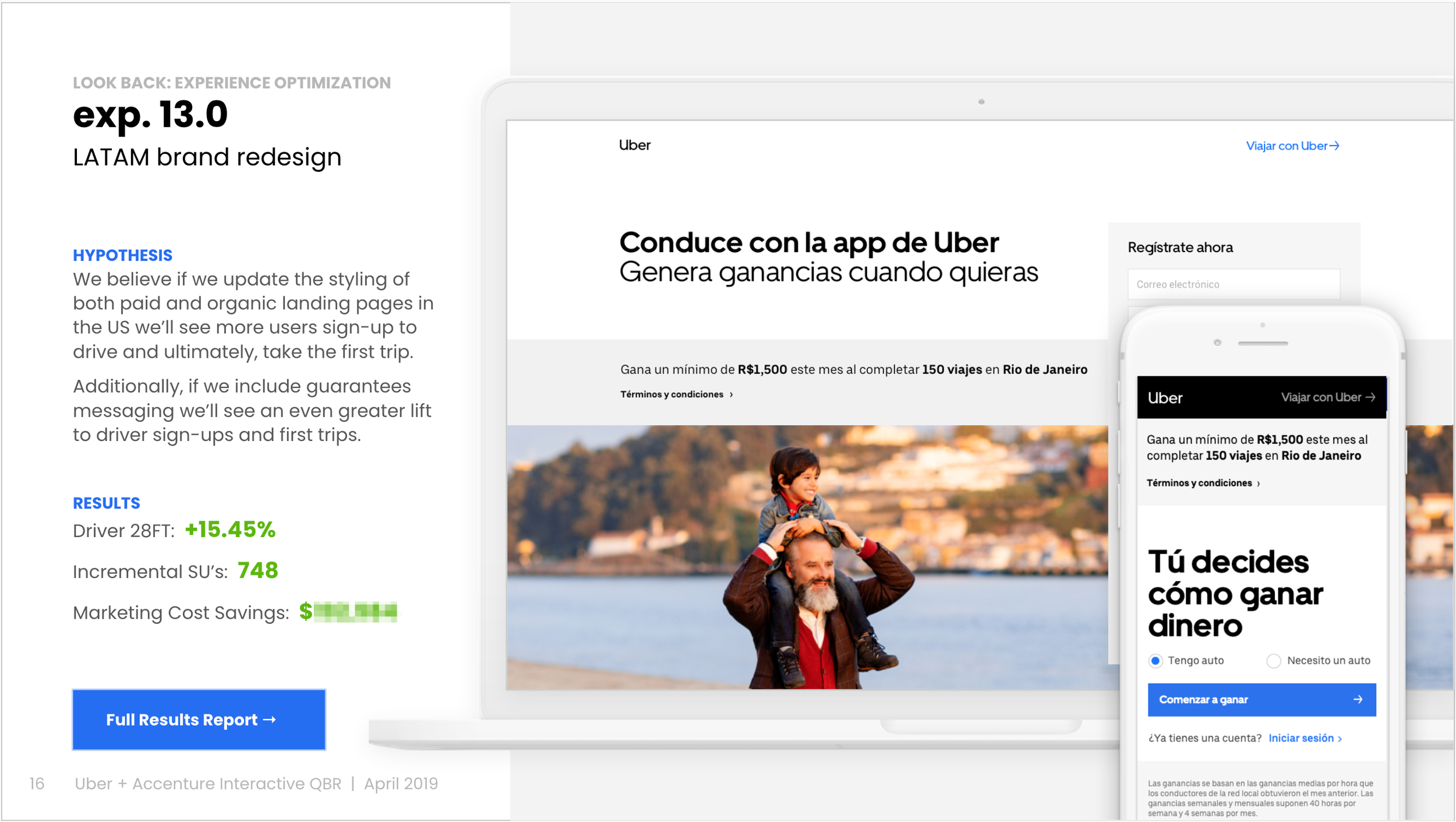
While working on the Uber account, we conducted 39 UX experiments to boost organic traffic and driver sign-ups on the platform. These efforts proved highly successful, resulting in millions of dollars in marketing cost savings.
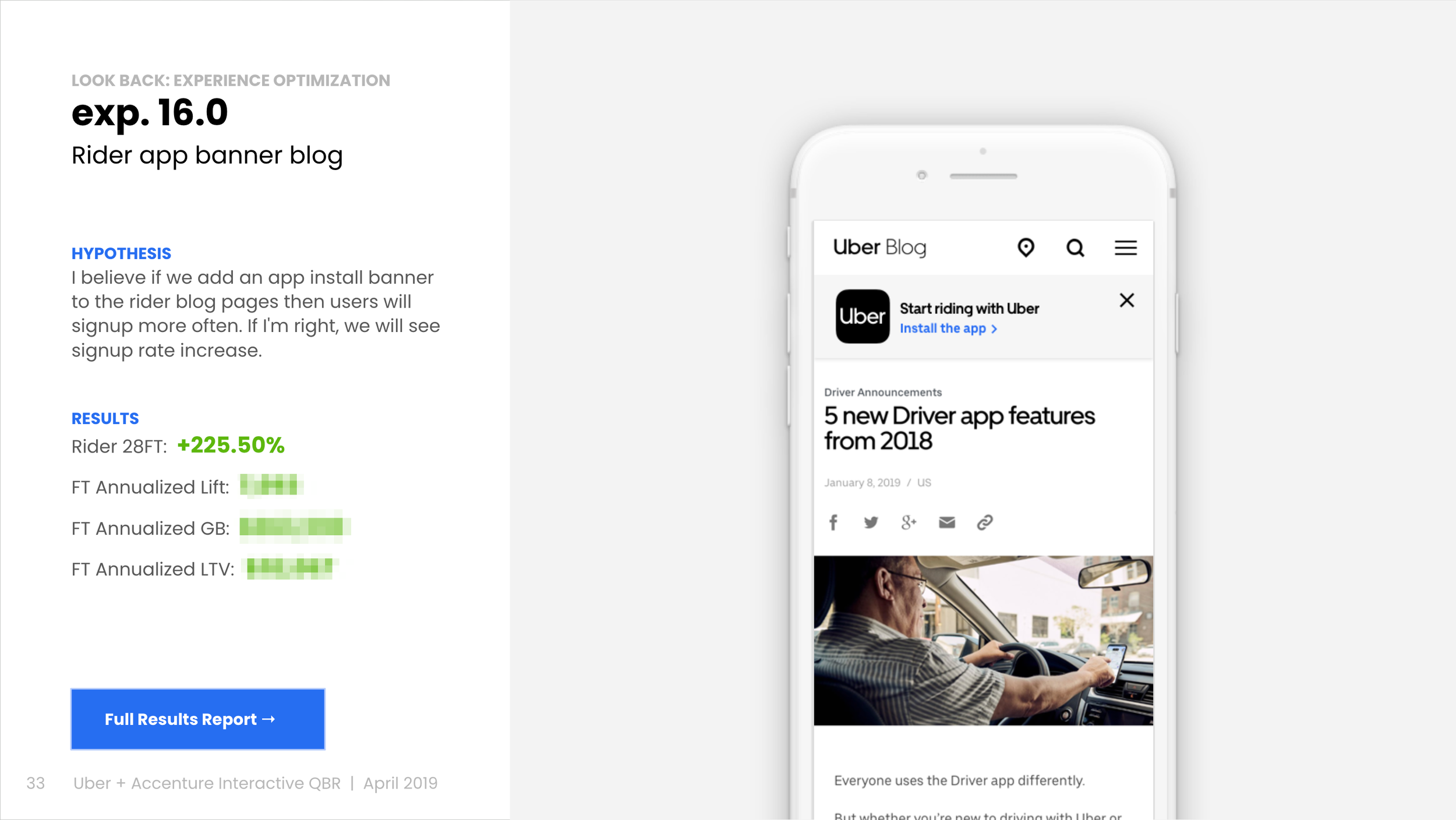
In one of our experiments, we offered users the option to directly download or use the Uber app to go through the onboarding flow. The hypothesis was that many potential drivers were already riders, thus simplifying and greatly accelerating the onboarding process.
We experimented for several months to obtain statistically significant results. However, the data did not support our hypothesis. 30% of users downloaded the app, and only 2% completed the onboarding process. In other words, the experiment was a failure.
I consulted with my analyst and account manager and asked if it made sense to them that 99% of users would go through the trouble of downloading the app only to give up. We suspected that existing Uber riders with accounts were not being counted, which would be a massive discovery if proven to be true. The Uber measurement team assured us this was not the case; we requested permission to conduct another experiment to prove or disprove this theory but were denied.
I then asked Uber's digital marketing team if they could track a specific user through the entire flow if I provided an email address, and they confirmed that they could. Since I already had an Uber account, I went through the onboarding process myself as a driver. I asked the team to search for my account and discovered that existing riders becoming drivers were not being accounted for due to a simple bug in the code.
This revelation changed the entire story of the optimization program that year and led to the promotion of the digital marketing lead to oversee the entire Uber digital marketing program.
WHEN
In 2019, during the peak of the rideshare market before the pandemic.
WHERE
Enhancing the Uber.com website and its in-app interface.
WHY
We all think about Uber from the user's experience. I need to go [to this place] and need [a way to get there] in a [time] that is adequate. But the business of Uber is fueled by acquiring drivers — No drivers, no user experience, no business. Being a data-centric organization, Uber has a clear measurement of success. The digital marketing team is measured on the number of drivers onboarded divided by the marketing costs of acquiring a driver (this is the entire journey, from filling out the first form to taking the very first trip).
Uber came to us to improve the UX of the onboarding experience to reduce paid traffic costs and augment organic traffic flow to onboarding.
HOW
It all begins with setting S.M.A.R.T. goals.
Next, identifying the problems hindering achieving those goals.
After that, brainstorming and coming up with possible solutions or hypotheses to mitigate those problems.
From this collection of hypotheses, professional experts in UX, like myself, built a program converting the hypotheses into actionable tests.
We conducted A/B tests by altering the user experience for a portion of the traffic until we attained statistical significance. This approach helped us minimize risks associated with changes. In our case, it led to significant savings in marketing costs, making our engagement highly valuable.